|
Did you know?
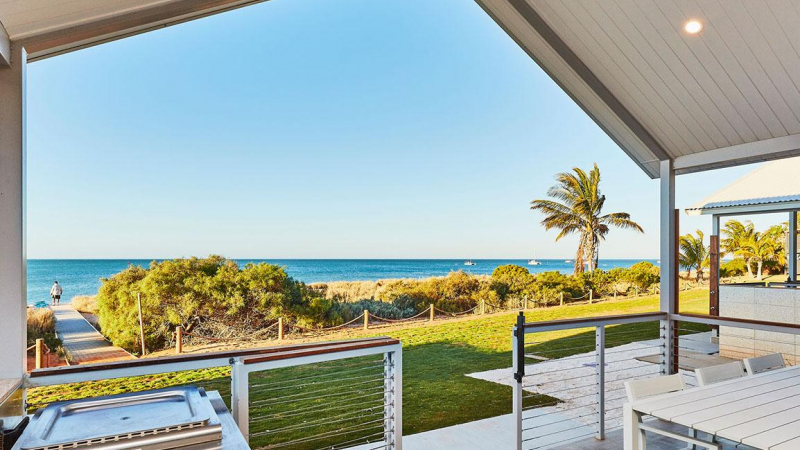
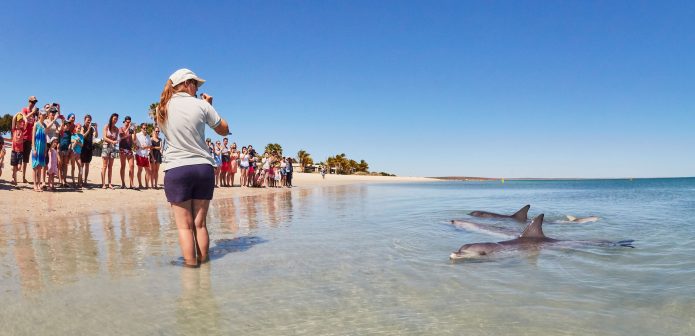
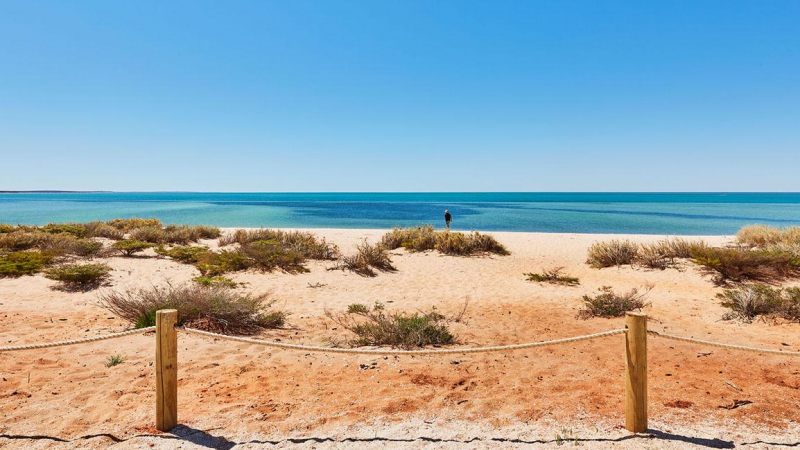
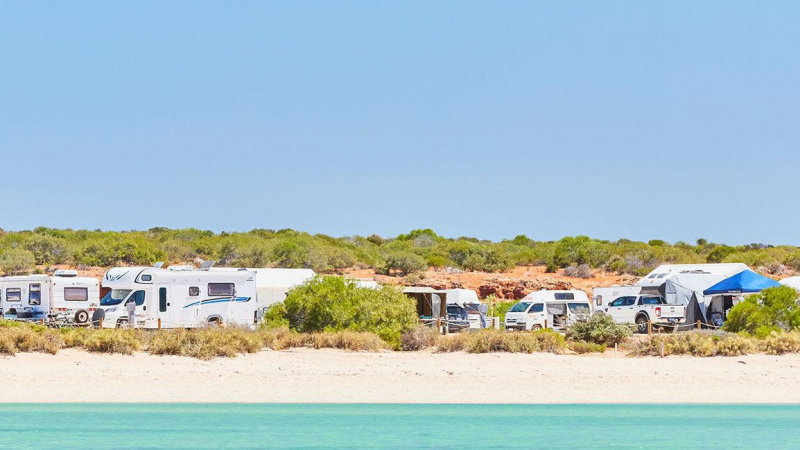
Located at Dolphin Beach, famous for its kilometres of secluded crystal blue waters and pristine white-shell beaches, Monkey Mia has attracted schools of dolphins to its tranquil shores daily for more than forty years.
This dolphin interaction is known to be one of the most reliable meeting places for dolphins in the world. Dolphins have visited everyday in the last five years excluding only four times. It is the only place in Australia where dolphins visit daily, not seasonally. Researchers from across the world come to Monkey Mia to study dolphins.
Dolphin News!
August 2012
Monkey Mia is very excited as two of our much loved regular beach visiting Dolphins Nicky & Kiya are both expecting calves later this year!
Nicky is due late October. Kiya is due late November, early December.
We can't wait to find out if we will be having boy or girl calves!
Stay tuned for more baby news.
November 2011
Monkey Mia welcomes another new addition to the Dolphin pod with calf Piper being born last week.
It is believed that regular beach visiting Dolphin ‘Piccolo’ gave birth to her calf on Wednesday last week, and surprised beachgoers and onlookers by showing off her new baby calf for the first time at the popular Dolphin beach on Thursday morning.
Piper has two siblings, Eden who is 8 and Flute who is 4 and is the fourth generation in the feeding program since the inception of the interaction program at Monkey Mia.
In a media statement, environment Minister Bill Marmion stresses the importance of protecting the mother and calf in the first few weeks.
“This new calf is particularly small and great care will need to be taken to ensure the greatest chance of survival of the newborn. To protect the welfare of Piccolo and her calf, Department of Environment and Conservation (DEC) staff at Monkey Mia will be asking the public to remain at the water’s edge when the mother and calf are inshore to prevent the calf from beaching itself”
Monkey Mia Dolphin Resort Manager, Martin Grenside said that guests have been delighted to experience the welcoming of a new baby calf to the dolphin pod.
“Guests arriving over the last few days have all heard the news of Piper’s birth and have been thrilled to see the baby dolphin during its first few days at the morning feedings”
The presence of the calf in the group of dolphins that visit Monkey Mia will be closely managed by DEC to ensure that visitors can enjoy interacting with these animals while protecting their welfare.
For more information on DEC – Dolphin behaviour and research visit www.dec.wa.gov.au
January 2010
Monkey Mia welcomes another new addition with baby Khamun being born on 27th December 2009, the second arrival within two weeks.
Named by the students of Shark Bay Primary school, Khamun is the first calf born to Kiya, one of the areas regular beach visiting dolphins. Kiya’s mother Puck also gave birth just two weeks prior to Samu.
Department of Environment and Conservation (DEC) Shark Bay district manager Brett Fitzgerald said the name Khamun was chosen because of its relationship with the calf’s mother’s name.
“A competition was run in The West Australian newspaper in 1997 to choose Kiya’s name. Egyptian history experts list Kiya as possibly the mother of the Pharaoh Tutankhamun and Khamun is an interpretation of the name Tutankhamun” he said.
Khamun’s arrival so close to Samu was a surprise with Kiya giving birth to Khamun approximately 6 weeks earlier than predicted.
Monkey Mia Dolphin Resort Duty Manager, Maria Cozis said that it was no surprise that during the first few days Khamun demonstrated a vivacious personality.
“Khamun displayed a very lively and active personality during the first days of life, and that is what we would expect from Kiya’s first offspring, as Kiya herself showed the same characteristics throughout her childhood and adolescent years”
Khamun brings the total number of dolphins that regularly visit Monkey Mia to 15 which is the largest number recorded since changes to the dolphin management regime in 1995.
The presence of two very young calves in the group of dolphins that visit Monkey Mia will be closely managed by DEC to ensure that visitors can enjoy interacting with these animals while protecting their welfare.
For more information on DEC – Dolphin behaviour and research visit www.dec.wa.gov.au
December 2009
The latest edition to the Monkey Mia dolphin family ‘Samu’ was born on Friday night.
Researchers and filmcrew from the UK are in Shark Bay making documentary for the BBC’s Natural World series. The working title for the film is The Dolphins of Shark Bay and it follows the story of Puck's family over a year. Luck would have it that the filmcrew have chosen the best year possible to make this film as Puck has just had her calf and her daughter Kiya is due to give birth in February.
Department of Environment and Conservation (DEC) Shark Bay district manager Brett Fitzgerald said both mother and calf are doing well, with the newborn measuring approximately 60cm long.
“The dolphins that visit the Monkey Mia beach are a matriarchal group consisting of three unrelated adult females and a selection of their calves, some of whom are now also adult females,” he said.
“The calf’s proud new mum Puck is one of five adult female dolphins in the group who are fed as part of a supervised program.”
Nick Stringer – Producer and Director of Big Wave Productions gave us his first hand account of events leading up to this very special event:
“We saw Puck around 5pm on Friday and she still hadn't given birth. We were actually starting to wonder whether it was going to happen while we were here as people had been predicting it would come as early as September. The purpose of entire shoot was to capture the days leading up to the birth and the first days of the calf’s life. There was much relief and it was fantastic to witness the first few hours of the dolphin's life. It certainly will go down as one of the highlights of my wildlife film-making career.
I was lucky enough to see the calf first. We had come down to the beach at Monkey Mia around 6am on Saturday morning. And I could just make out a tiny fin about 200m offshore. I ran to the end of the pier and borrowed a German tourist's long lens and low and behold it was there. I used the same camera to take the first picture of the calf. “
The latest addition to the Monkey Mia dolphin family has been named ‘Samu’ in recognition and respect of research scientist Dr Amy Samuels whose findings provided valuable insight into dolphin behaviour.
“Dr Samuels was a longstanding researcher at Monkey Mia. She visited on a regular basis from her home town in the USA where she lost her battle with cancer in December last year at the age of 57,” he said.
“She had a long career with wildlife research on a range of species including dolphins and her research and advice has played an important role in how DEC manages the welfare of the dolphins in Shark Bay, particularly at Monkey Mia.”
Indo-Pacific Bottlenose dolphin (Tursiops aduncus) calves are born 12 months after mating and will usually suckle for up to four years. The sex of a calf cannot be determined until it is 6 months old.
The first few days of the calf's life are fascinating and the filmcrew will be trying to film some of the following behaviours for their documentary.......
- The calf swims really erratically in the first hours and days of its life. It’s comical to watch it going like a wind up toy, non-stop. Apparently, they can’t stop swimming because they don’t yet have enough blubber to stay afloat.
- In the first few hours, they don’t know how to breathe and the mother will often push them to the surface.
- The calves are very sensitive to movement and will follow anything that moves. Mother has to keep them very close to her side. Other curious dolphins often take advantage of this and race past the calf to try to steal it. The mother then has to race back past to recapture the calf. There’s nothing malicious in the stealing, the other dolphins are just curious.
- Quite often the calf will hang around the mother’s head. Apparently to imprint of the mother’s unique signature whistle. It takes a while for the calf to learn its mother’s whistle and it’s very prone to getting lost and being taken by the shark, so the mother keeps the calf very close.
- Because the calf is constantly swimming and feeding every 2-3 minutes the mother doesn’t get much rest or time to hunt and feed. She can go without food for several days, until the calf is able to dive and follow her on hunting sorties.
- The filmcrew will be returning to Monkey Mia next April/May to see how the family is doing and complete their documentary.
If you would like any more info on the film and Big Wave Productions please go to website at www.bigwavetv.com.
In other Dolphin news...
Monkey Mia dolphin "Shock" has now been fully integrated into the public feeding program and there are now five provisioned dolphins that are able to be fed by the public.
Monkey Mia dolphins are the only dolphins in the world known to use ‘tools.’ For example some use sea-sponges to protect their snouts when they hunt!
The brain of a bottlenose dolphin is bigger than that of a human!
‘Wedges,’ one of the local dolphins, enjoys catching Golden Trevally (a large Australian fish). He was once seen hunting a particular Trevally for over an hour!
Many dolphins of the region often herd fish onto the beach and then search in waters just several centimetres deep to catch them!
Adult dolphins hang out in groups of two or more called ‘alliances.’ These alliances cruise together in search of a female and just like a group of boys they’ll compete to win her heart! They may spend up to a month pursuing a particularly attractive female.
Dolphin youngsters have a close bond with their mother who teaches them hunting, survival and social skills.
Click Here to view the dolphin film in our Movie Gallery
For more information on DEC – Dolphin behavior and research visit www.dec.wa.gov.au
Download our Dolphin Fin Chart here
|